Category Archives: Vintage

A quick review of Hotshot 2007 (based on manual), UPDATED July 24th

After having a look at the manual of the Hotshot 2007, I feel that the Hotshot 2007 is the poorest of the re-releases so far. I can appreciate it as a re-release being quite true to the original, but considering that many parts have been improved, I have difficulties understanding why many of the weaknesses haven’t been fixed, more so as other models in the Hotshot series (especially the Hotshot 2), had many of the Hotshot’s problems fixed. Problems that are now “revived” with the re-release. Tamiya will sure have their well considered reasons, and unlike me, those who wanted the re-release to be as close to the original as possible, will have their wish at least partially granted. As nice and interesting as the Hotshot 1 looks, a re-release close to the original is a welcome flashback, but it also means that it remains the most “immature” design in the Hotshot series.

Below a little list on details that the review of the manual has revealed, and which couldn’t be recognized on the pictures earlier available, or otherwise made known.

1. Diff joints without the integral 2mm pin (loose pin instead): More slop, higher frictionlosses and wear. The fixed pin was introduced with the Hotshot 2 and has been a standard feature for most Tamiya models since and it offers significant benefits over the “loose design”, as described in one of my earlier comments.

2. The same amount of ball bearings are included as with the original release. Considering how unprecise and inefficient the Hotshot gearbox design is, how important full ball bearings are and the fact that ball bearings aren’t by far as expensive as they were in the mid ’80’s, I would have expected Tamiya to include them. This is of course a cost issue, but as I’m sure almost all buyers will mount full ball bearings anyway, a slightly higher kit price for a kit with full ball bearings, would in my humble opinion have made more sense.

3. Pinion spacing arrangement is the same as the original release, instead of the much improved Hotshot 2 arrangement: Fiddly and more likely to get debris inside the rear gearbox. Not so critical on new and clean parts, but from past experience with the original, I know just too well how awkward this used to be.

4. As far as I can see, aluminum front bumper hex instead of brass, like later models in the Hotshot series: Threads strip much more easily, a very well known problem with the original release.

5. Not self tapping screws for radiobox, as introduced with the Hotshot 2: Much more difficult access to radiogear and more likely stripping of screwheads. (I will grease the screws on mine). I of course realise that entry to the radiobox will be less necessary now that the mechanical speed control is gone, but considering that the Hotshot 2007 has the Hotshot 2 tub, which has a quite strong visual impact, I consider it surprising that the “invisible” improvement of using selftapping screws has not been applied.

6. No 850 bearings for the diffjoints (outside the 1150 bearings) and no advice to add them to reduce diff joint slop, as with the Bigwig. Unless the gearbox housings have been modified, making fitting of these 4 extra 850 bearings impossible, I will add them on mine.

On the positive side, except the things we knew about already:

1. Reinforced rear upper arms in the lever area of the monoshock mount. A very much needed and truly welcome improvement!

2. Improved kingpin design. Hex head instead of screwdriver head (first release) and Phillips head (improved Hotshot 1 and later). The “hex” is smaller in diameter and thus will probably cause less wear on the “ballcup area” of the suspension arms (less/no grinding) and more important, makes assembly by far easier.

3. E-clips instead of C-clips for the diffjoints. The original’s c-clips were fiddly to mount, ever worse to remove and tiny, so were easily lost during assembly and maintenance. The larger E-clips surely offer a benefit here, and may also add a little more of the very much needed stability to the diff assembly.

4. Rubber boot on switch. Not important, but a nice touch.

5. Reinforced wing mount. Two almost vertical “struts” have been added. A little strange as the original was indeed adequate, but with no significant visual impact or other disadvantages, still welcome.

6. Hotshot 2 / TA01 type front uprights. Reduced bumpsteer compared to the original Hotshot’s upright type. For the purists, the original Hotshot 1 type uprights are included as well (on the D-parts tree), but marked as “not used” in the parts overview.

7. Both a steel antenna (like Hotshot 1) and a plastic antenna pipe with aluminum holder!

So, do I look forward to receiving the kit, which is currently in transit? Yes, I do. It will be nice to “travel” back to May 1st 1985, when I built my first Hotshot and seeing it finished in all its visual glory will be a joy. However, now knowing to a large extent how it will run, I think mine will stay a “static” model after assembly. After the XR311, the first re-release I don’t really feel any desire to run!

Update: Tamiya HQ obviously doesn’t have a problem admitting that the Hotshot 2007 is based on a very outdated design with limited positive characteristics in absolute technical terms, with focus on nostalgy rather than actual performance. Quote from Tamiya HQ’s English website: “Take this updated Hotshot out for a spin and compare it to today’s R/C buggies to experience how far this hobby has developed!”

More here: http://www.tamiya.com/english/products/58391hotshot/index.htm

A few considerations about the 58391 “Hotshot 2007”

After having read many Tamiya enthusiasts’ reactions to recent news about the Hotshot re-release, it feels appropriate to make a few comments. The text below is solely my subjective opinion, but the opinion is based on using the Hotshot and the subsequent models in the “Hotshot series” for organized racing on national level for three buggy racing seasons and servicing countless of customers’ Hotshot series models (Hotshot, Hotshot 2, Supershot, Boomerang, Bigwig and Super Sabre). In other words, my opinion is at least not just based on random guesses.

Many enthusiasts have commented that they would like Tamiya to re-release the Hotshot in its original form. For nostalgic reasons I’m tempted to agree, but for anyone who would like to run the “new” Hotshot and already have extensive experience with the “old” one, it’s rather obvious that a re-released Hotshot would need major improvements to be durable and have acceptable wear and handling. As nice as the original Hotshot is for static display and the occasional very careful run, it’s pretty much useless compared to practically any modern model. As virtually any part on the original Hotshot has major flaws in the design and/or choice of material, what I consider to be a good re-release can’t possibly have much in common with the original.
Before addressing the Hotshot’s many and among longtime enthusiasts well known flaws, I would like to make a few comments about some of the models that Tamiya has already re-released, more or less in their original form. Many of them have kept many of the flaws they had when they were first released “back then”, but most of these flaws are acceptable, as they don’t reduce performance and durability to unacceptable levels. Though being rather outdated as “racers”, the Top Force and Manta Ray are still relatively close to current technology and both handling and durability are fully adequate for fun runners, and as such fully acceptable that they were released without any major improvements. That is certainly not the case for the Grasshopper, Hornet, Frog and Brat, but having very simple and basic designs, no sensible enthusiast would expect fine handling and even the durability and wear issues can be tolerated. That would in my humble opinion certainly not be the case if the Hotshot would be re-released with most or all of its original flaws. After all, Tamiya hasn’t offered the other re-releases as “fragile, outdated, unsuitable for anything but light running, static model collector’s” items”! The re-released Hotshot should also be suitable for what RC-cars are primarily made for; running, not just displaying.
When the Hotshot was first released in 1985, it was a pioneer in using low profile tires, and arguably being the first electric 4WD buggy with a reasonably efficient and reliable drivetrain. However, measured against its major serious competitor of the time, the Associated RC10, it could hardly be considered a serious attempt at making a competitive buggy for organized racing. Even the Kyosho Progress would have been totally superior, if it hadn’t been for the excessive complexity that caused maintenance and durability issues. At the time, my work and sponsorship meant I had to and benefited from racing Tamiya products, and in hindsight, I can easily admit that I was pretty biased at that time, and didn’t want to realise how “weak” the Hotshot was in most terms.
Though I loved the Hotshot back then and still love the look of it, I think hardly any other Tamiya model is so unsuitable for re-releasing in its original form. Apart from the rollcage and the improved second generation bumper, there are almost no parts on the Hotshot that I would consider to be of good design, have a suitable choice of materials or acceptable durability, especially when measured to today’s standards. As nice as it looks and as important as it is to Tamiya’s heritage and myth, the Hotshot must be the Tamiya model with the most flaws of all time, even when considering the Juggernaut, Striker and a few of the not so great models made by Tamiya.
The red parts were all very fragile, except for the rear uprights and stabilizer mounts (though they shattered too). Cracking front uprights, servo mounts, battery door hinge, the damper plastic parts and of course wheelhubs were all big problems. Disintegrating propshaft and dogbones, although very expensive compared to later and simpler onepiece designs, was very common too. The first generation Hotshot also had a big problem with bent kingpin threads as they were 3mm instead of the later 4mm, causing even more rubbing of the front wheels against the suspension arms, a big problem even with all parts intact, especially before many improvements were introduced. Needless to say, the MSC was crap and also very difficult to maintain, as the cramped radio box was mounted to the upper chassis with long screws that were often difficult to unscrew without stripping their heads. This problem wasn’t solved before the introduction of the Hotshot 2, using selftapping screws. The resistors’ ceramic material pulverized due to the constant vibrations, making the resistors rattle about inside the aluminium housings, and mostly sooner than later fail completely. Having turned aluminium housings for improved cooling, they cost a whopping USD10,- each to replace (in 1985!), without offering any actual benefit over the regular (and cheap) “sugarlump” resistors. Yes, they look great, but my appreciation for a design where the traditional wisdom “form follows function” must have been completely ignored, is very limited. An important reason for welcoming the ESC of the re-release, regardless whether it will be placed “unreachable” inside a tub or not!
Furthermore, front stabilizer mounts broke easily, especially the “fork” part, rear stabilizer practically never stayed in the mounts on the rollcage, making the rear stabilizer useless most of the time, the aluminium bumper mount hex easily stripped (before being changed to brass), and the first generation front gearbox was also weak in the bumper mount area. The upper rear suspension arms used to break in the “L”-mount area for the monoshock when both sides bottomed out at the same time and also simply for general fatigue. The upper front suspension arms were extremely sloppy, causing severe wobbling of the front wheels at high speed, and all suspension arms would break at a rate unthinkable with any current design. Diffs were pretty unreliable, and the slop in the whole diff design caused gearbox joints to wear out prematurely. This could to some extent be counteracted by placing 850 bearings outside the original 1150 bearings, like the racers started doing right after the Hotshot’s release and Tamiya themselves introduced later (too late!) on the Bigwig. Springs, not being of spring steel, caused the (front) suspension to sag after a short time, making it necessary to run the front at the stiffest setting, which again of course wasn’t exactly beneficial for handling, with the inappropriate ride height and the already inadequate front suspension geometry getting even worse. By the way, as for touching handling, though not being durability issues, the hard tires, poor dampers and extreme bumpsteer were joykillers as well, especially for the owners who struggled to be competitive in organized racing.
With this long list, we’re only talking about the problems for knowledgeable and experienced owners, and I’m sure I have forgotten something too! For the majority of customers, the poor design combined with lack of knowledge, caused even more problems.
Don’t get me wrong, I look forward to the re-release too, but rather than a model just suitable as a “static” model for the showcase, I would prefer a massively improved design, or even better, a completely different modern design like the DF-03 chassis, but with monoshocks, rollcage and correct colour coding of all visible parts. After all, a re-release identical to the original would not convey the same nostalgic feelings or appreciation of collectibility as an original model anyway. A completely new model with the basic looks of the Hotshot would allow for the best of two worlds in my opinion; a greatlooking model suitable for resurrecting those mid-eighties memories, but suitable for running, with handling and durability we could only dream of “back then”.
As relatively little information has been made available about the “Hotshot 2007” at the time of writing this (April 27th ’07), it remains to be seen how far Tamiya has gone with the redesigns and improvements, or if they have even opted for a totally new interpretation of how the chassis of a revived Hotshot should be.
With the release of the Avante Mk. II, Tamiya has demonstrated their understanding of what the market really wants. Outside Japan, the Mk. II has been criticised for being too far away from the original Avante’s concept, and though surely a few Japanese enthusiasts would agree, I’m confident that the sales volume on Tamiya’s most important market (Japan), will prove Tamiya’s strategy to be correct. Only time will show whether the same strategy will be applied for the re-release of the Hotshot. Regardless how the Hotshot 2007 turns out to be, and the occasional miss in the past (unavoidable for a big, innovative and trendsetting company like Tamiya), rest assured that 6 decades of success means that the people at Tamiya’s Shizuoka headquarters know very well what they are doing.

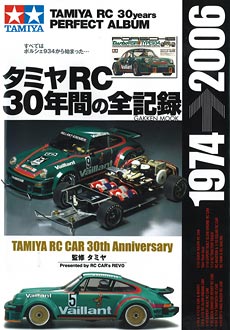
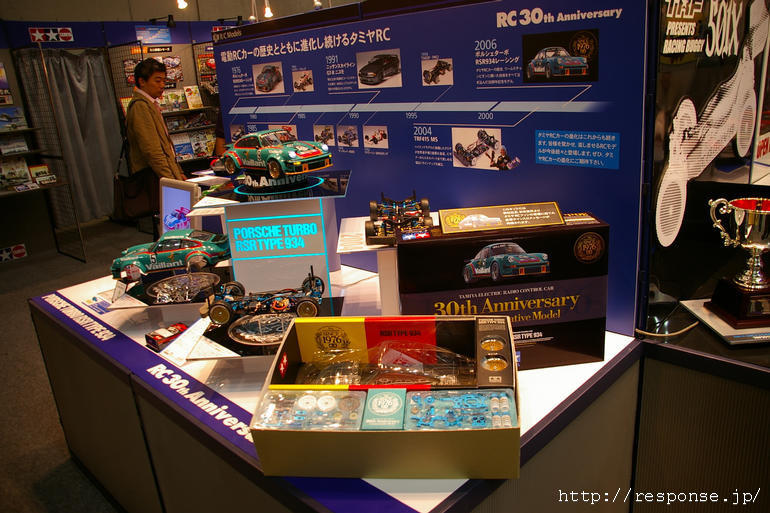
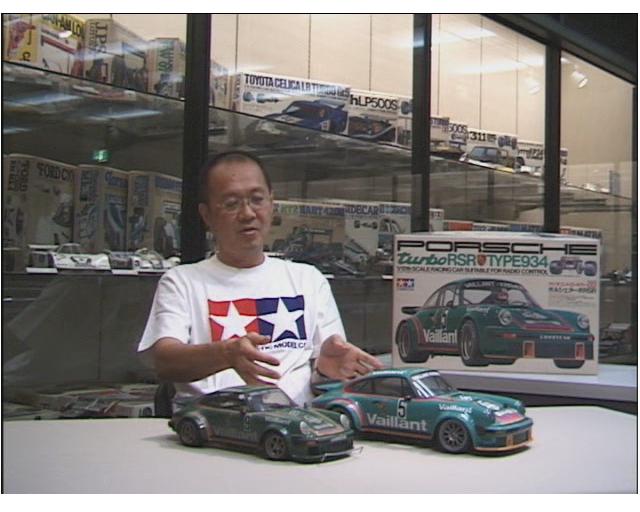
Interview and video with Tamiya Porsche Turbo RSR 934 designer Fumito Taki (Dr. Waterfall), also future view of RC cars (smell module for electric cars to smell like real ones?)

The opportunity which makes the Q.1 electromotive RC car

At that time, the fact that I speed am present tremendously by the racing car of 1/8 was done. However, sound being large, in order to be able to send, because the wide place it was necessary, when the RC car is made by electromotion, that with your own hobby, proposed desired ones to the company whether it is not to be possible at the various place. Exactly, because plan of 1/12 Porsche scale model was the under way, the president this that to be a story which you say whether it cannot make the RC car, could do the RC car that as an opportunity, it is.

The point which Q.2 development anecdote suffers hardship

Because we like this work, there is no hardship, is, but because that time when it developed there was no private motor of the RC car, some motor is good from the motor for industry which is marketed? With the test machine was made in order to select the fact that you say. In a manner of speaking, it is the measurement equipment. The data was taken in various ways with that. At that time, various technical basic research was done in addition to extent and the motor where the data becomes thick. From among such, being original, it had making the RC car private motor, it is.
As a funny episode, Porsche of the actual car met to the company in order this to make the scale model it is, but riding that, it went to the demonstration where the various manufacturer of Nagoya RC gets together. So, [huruchiyun] doing this RC Porsche, when it can send the electric battery and the motor at all in the different thing, it was faster than the engine car. The person of the manufacturer of the engine car which that is “just a little demonstration you stopped and” with, there was also a kind of thing which is said.

Q.3 [tamiya] RC future view

Because it became that this Porsche anniversary model appears, when you say that smell of oil does returning to starting point once more in opportunity, interest of the RC that car, as a car, perhaps, difficult to understand, but, we would like to make the kind of model which smell of such genuine car does, when is, we would like to keep making the kind of model to which dream keeps spreading from the model.

Online translation from Tamiya’s Japanese homepage where also the videos can be found