By Yasumasa Matsui: Former TV Asahi announcer. Journalist. News reporter.
Tamiya, now a global brand, didn’t have a smooth sailing start. Their first plastic model, the Yamato, didn’t sell well, and at one point the company faced a crisis of survival. Furthermore, overseas, they were simply ignored because their products were “Made in Japan.” So how did Tamiya manage to rise from there to become “Tamiya of the World”? Behind it all were their unique manufacturing approach that prioritized “ease of assembly” rather than just pursuing precision, and the presence of two brothers. *This article is an excerpt and edited version of “Half a Century with Plastic Models” by Yasumasa Matsui, former TV Asahi announcer (Chuokoron Shinsha).
Tamiya ‘s first model kit, the Yamato, failed to sell, putting the company in grave danger.
What makes Tamiya products so great? From the packaging design to the precision, the attractive lineup, the total product range including assembly tools and paints, the development and operation of numerous events, and the excellent customer service… there are so many things that come to mind. But what I especially want to convey to everyone is the “ease of building” of the kits. Tamiya plastic models are fun to build.
Most Japanese plastic model manufacturers founded during the Showa era started out as wooden model manufacturers. Tamiya, too, had achieved great success with its large wooden models of warships, so its transition to plastic models, which were a huge boom after being introduced from overseas, was slower than its competitors. The first plastic model, the “1/800 Yamato,” was released in May 1960, but it clashed with the “Battleship Musashi,” a plastic model released earlier by a rival company, and sales were poor, putting the company at risk of collapse.
Thorough research of the actual object to create a precise kit
However, the massive success of the “Panther Tank,” released in January 1962, led to a miraculous V-shaped recovery, and the slot racing boom that began in 1965 expanded sales channels overseas. But the most epoch-making product was undoubtedly the “1/12 Honda F-1,” released in November 1967.
Nowadays, it’s commonplace to conduct on-site research when developing new plastic model kits, but back then, it was normal to design based on drawings published in magazines and a limited number of photographs. However, Tamiya, with the full cooperation of Honda, went to the warehouse at Haneda Airport where the actual car was waiting to be airlifted for the Monaco Grand Prix to conduct on-site research for the development of the Honda F1. As mentioned earlier, this kit made a spectacular debut at Tamiya’s first Nuremberg International Trade Fair and became a huge hit.
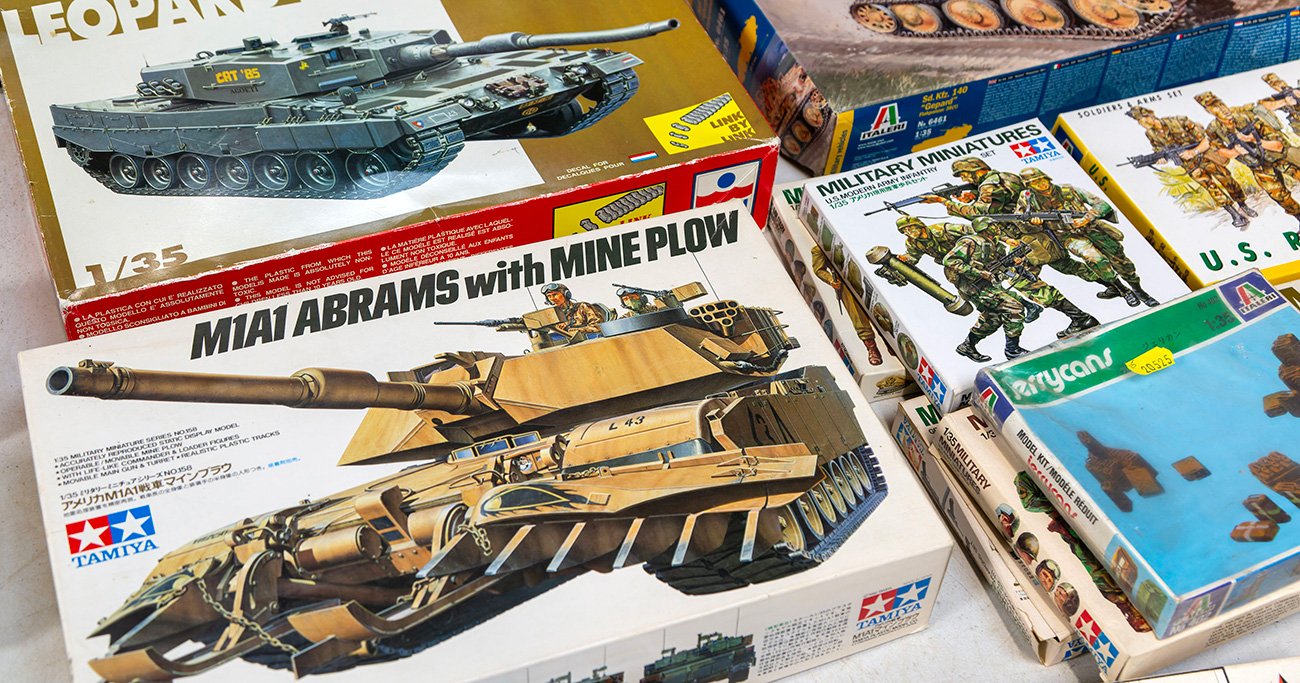
On the other hand, when it came to tank models, there were virtually no suitable subjects available for research domestically, so they went to the trouble of traveling to military museums overseas to conduct thorough photography and measurements. Thus, Tamiya’s scale model development, which began in the late 1960s, was based on “research of the real thing,” and a lineup of precise kits that set it apart from other companies began. All of this was handled by the young leader, Shunsaku Tamiya, then head of planning.
Other companies were not to be outdone. They also began conducting research on the actual objects, and a competition to develop more precise kits began. Amidst this, the general trend was to think that “the more parts there are, the more precise and better the kit,” but Tamiya consistently stuck to keeping the number of parts down and prioritizing ease of assembly.
Shunsaku Tamiya’s decision prioritized ease of assembly over precision.
There is a symbolic example: the large-scale motorcycle kit of the “1/6 Honda Dream CB750 FOUR,” released in December 1970. A dedicated young designer developed a movable structure for the drive chain, combining metal and plastic parts link by link. Indeed, even after completion, a natural slack is reproduced, and the sense of precision is outstanding. However, due to numerous complaints from customers that it was “difficult to assemble,” the chain section was replaced with a single molded part in the second edition. While he himself greatly appreciated the assembly method, it was the young Shunsaku Tamiya who prioritized ease of assembly and made this decision, taking cost into consideration as well.
Here’s another example of how easy it is to assemble: When attaching small, symmetrical parts to tanks or airplanes, it can be easy to get confused about which is which. Tamiya, however, has designed the parts with different numbers and sizes of mounting holes on the left and right sides to ensure that you can glue them in the correct position without making a mistake.
Furthermore, since the turn of the 21st century, Tamiya’s mold molding technology has become even more refined. When you combine the left and right parts of the airplane’s body and bring a brush with liquid adhesive close to them, the adhesive enters the seam through capillary action, making it impossible to tell where the joint is.
In recent years, Asian model manufacturers, in particular, have made remarkable progress, and some kits have even begun to surpass Tamiya in terms of precision. However, generally speaking, the parts division has become very fine, and some kits now have more than double the number of parts. The finished product is certainly wonderful, but the assembly is a difficult and arduous task. Tamiya, on the other hand, has consistently developed products that are “precise yet have a surprisingly small number of parts” through further improvements in its engraving technology. They can be assembled so quickly that it’s as if the parts are fitting together on their own. In short, Tamiya kits are stress-free and enjoyable to build, and you can move on to the next step, painting, with plenty of energy left over.
Farewell to Shunsaku Tamiya, Chairman who built “Tamiya of the World.”
It was a sudden phone call from someone. One day in July, shortly before the reopening of the history museum after renovations,
“Mr. Matsui… you heard it, didn’t you?”
“Huh? What is it?”
“Chairman Shunsaku… has passed away…”
“…”
I was in a daze for a while, unable to comprehend what was happening. A few days later, Tamiya made an official announcement. On July 18, 2025, Chairman Shunsaku passed away. He was 90 years old.
Everyone knew this day would come someday, but no one imagined it would happen so soon. Later, we learned that the closer you were to Chairman Shunsaku, the more unexpected and sudden this event was for you. He joined his family business, Tamiya Trading Co., Ltd., at the age of 23, and as a young leader, he steered the company through the most difficult period of transition from wooden models to plastic models. He essentially built Tamiya into a global plastic model manufacturer in just one generation, and continued to lead the industry for over 50 years. Tamiya fans all over Japan, and indeed the world, shed tears.
His younger brother, Tokuo, supported “Tamiya, the world’s leading company,” through his design work.
The sad events continue. On August 19th, about a month after Chairman Shunsaku’s passing, his younger brother, Tokuo Tamiya, who worked as a designer and art director at Tamiya, also passed away at the age of 87.
Tokuo is Shunsaku’s younger brother, three years his junior, and while he was a student at Tokyo University of the Arts, he was asked by his brother Shunsaku to design the first Tamiya “Twin Star” logo, and was deeply involved with Tamiya.
From 1967, he became a freelancer and established an office in Aoyama, Tokyo, where he oversaw all aspects of Tamiya’s design work as a designer and art director, a role he held until 1998.
Even as a child, I felt that Tamiya’s products were a step or two ahead of their competitors in every aspect, from the excellent kits themselves to the packaging, catalogs, flyers, magazine advertisements, merchandise, and even their company envelopes.
Everything was unified in design around the Tamiya Twin Star mark. The contributions of its creator, Tokuo Tamiya, are immeasurable. Although the term CI (Corporate Identity) is now commonly used, it is astonishing that he was one of the first to adopt this concept more than half a century ago and thoroughly embody it. This was all built by one man, Tokuo Tamiya.
Later, in an article reflecting on that time, Tokuo wrote:
Book cover of “Half a Century of Me and Plastic Models”
” My Half-Century with Plastic Models ” (Yasumasa Matsui, Chuokoron-Shinsha)
“How can we make Tamiya a company that can compete on a global level? We want to change the image of it being just a toy. How can we raise the level of perception in the model industry?”
It is written that they came up with this unified design through trial and error.
Mr. Tokuo redesigned Tamiya’s now-used Twin Star logo around the time when the young Chairman Shunsaku had traveled alone to America to sell Tamiya products, but was rejected simply because they were “Japanese products” (at that time, “Made in Japan” was used in a negative sense), and returned to Japan heartbroken. By proclaiming in the company motto, “We must be the best in the world, not just the best in Japan,” he developed the groundbreaking “1/12 Honda F-1” model and exhibited it for the first time at the Nuremberg International Toy Fair in 1968, where this new Twin Star logo shone brightly on the top of the box.
Tamiya rose to become “Tamiya of the World” thanks to the combined efforts of these two brothers.
Source in Japanese language: DIAMOND online